



TSA Greenlights Medical Marijuana! The Transportation Security Administration made a notable,and long-overdue, change to its official travel guidance, listing medical marijuana as permitted in both carry-on and checked bags on its “What Can I Bring?” page. The page was revised on April 27, 2026, marking the first time a federal agency stationed at airport checkpoints has officially acknowledged any form of cannabis as something other than outright illegal. The policy shift raises as many questions as it answers.
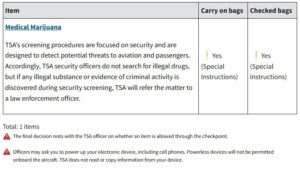 TSA’s “What Can I Bring?” tool now shows medical marijuana with a “Yes” for both carry-on bags and checked bags but it’s flagged under the agency’s “Special Instructions” designation. Two other changes on the page are subtle but significant. The paragraph that previously declared marijuana illegal under federal law has been removed entirely. In addition, the agency’s long-standing language, which stated that TSA officers do not search for “marijuana or other illegal drugs,” has been quietly edited to simply say “illegal drugs”. This single-word deletion has meaningful implications.
The update to the tool was done one day before Acting Attorney General Todd Blanche’s rescheduling order took effect on April 28, 2026. The rescheduling order moved medical cannabis products from Schedule I to Schedule III under the Controlled Substances Act. All cannabis products have been Schedule I since President Nixon signed that law 56 years ago.
The April 2026 rescheduling order didn’t legalize all cannabis for everyone. Instead, it created what many are calling a “two-tier” federal cannabis framework. Two specific categories of products moved to Schedule III: FDA-approved cannabis-derived pharmaceuticals (such as Epidiolex, Marinol, Syndros, and Cesamet) and cannabis products that are regulated under a qualifying state medical program. Everything else (ie: recreational marijuana in legal states) remains Schedule I under federal law.
In practical terms, the legal status of the cannabis in your bag now depends heavily on its documentation and origin. A prescription bottle from a licensed pharmacist is quickly recognized as a prescription. Medical marijuana is not so readily known as a prescription and a valid mmj license/card must also be in your possession to prove medical use.
While TSA labels MMJ with the “Special Instructions” label, there are no actual instructions available on the page. The TSA uses this designation for other sensitive items with detailed compliance requirements. Firearms can travel in checked bags only, unloaded, in a locked hard-sided container, declared at the airline counter. Lithium batteries must travel carry-on, within specific watt-hour limits, with terminals protected. Medical marijuana gets the label, but no actual instructions.
There is no published guidance on how much medical marijuana a passenger may carry. There is no indication of what documentation-like a state medical card, a physician’s recommendation, a prescription label-is required or sufficient. There is nothing telling a patient what to do when flying from a legal state to one without a medical program, or what happens when state marijuana laws conflict with the new federal framework at the checkpoint.
The TSA’s existing referral language also remains on the page: if a TSA officer discovers cannabis during screening, the matter is referred to a law enforcement officer. That officer operates under state law, and outcomes can vary dramatically by location. In states like California, a patient might simply be asked to dispose of the product before proceeding. In states where cannabis remains illegal, the consequences could be far more serious.
The updated guidance is primarily relevant to patients whose cannabis products fall within the newly rescheduled Schedule III categories-meaning those with FDA-approved cannabis pharmaceuticals or products from qualifying state medical programs. Recreational users are in a different situation since recreational marijuana is still Schedule I and remains federally illegal.
The scope of the affected population is significant. Approximately 23.4% of American adults — over 61 million people — used marijuana in 2024, and that number continues to grow each year as people are moving away from alcohol and pharmaceutical prescriptions in favor cannabis. Many of these adults choose not to get a medical marijuana card if they live in a recreational legal state. Even a fraction of that group traveling with medical products represents an enormous number of airport interactions without clear guidance.
Until the TSA publishes actual special instructions to accompany its new designation, medical marijuana patients face a zone of genuine legal ambiguity when flying. The agency’s mission is aviation security-detecting possible threats to aircraft and passengers. Cannabis discovery happens usually by chance, not because an agent is searching for it.
Local law enforcement makes the final call. If cannabis is found, airport police are called. What happens next depends entirely on the laws of the state where the airport is located — not where you’re going or where you came from.
Documentation matters more than ever. With legal status now tied to a product’s regulatory origin, having your state medical card, physician’s recommendation, and original product labeling could be the difference between a brief conversation and a serious legal problem.
Interstate travel is still a federal gray area. Crossing state lines with a Schedule III substance without a specific DEA-compliant prescription technically remains a federal matter, even if enforcement has been deprioritized.
The TSA’s update is historically significant as the first acknowledgment by a federal airport agency that some cannabis is no longer treated as illegal. However, a policy change without guidance is, at best, incomplete. Patients who have relied on medical marijuana for years deserve clarity about what they can actually carry with them, what documentation to have ready, and what the consequences might be if something goes wrong at a checkpoint.
The TSA’s new policy is less of a green light than a yellow one. It signals that change is underway, but travelers who proceed without caution may find themselves navigating rules that haven’t fully been written yet. It may be best to wait to carry your mmj with you until the “special instructions” are clarified.
